




























Views
Downloads
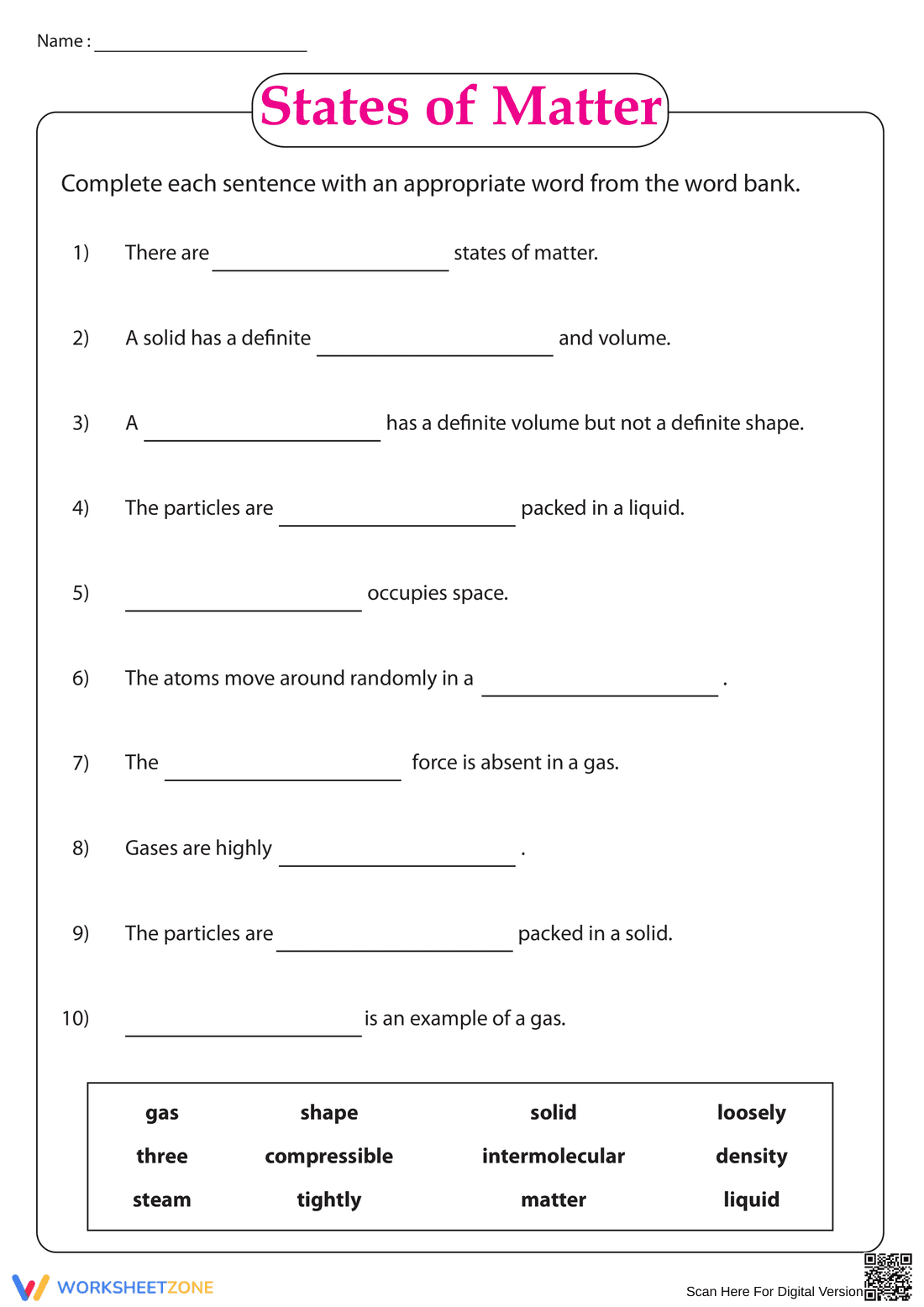

Essential States of Matter Worksheet | Grade 2-3 Science

Paste this activity's link or code into your existing LMS (Google Classroom, Canvas, Teams, Schoology, Moodle, etc.).
Students can open and work on the activity right away, with no student login required.
You'll still be able to track student progress and results from your teacher account.
This essential science resource helps elementary students master the fundamental properties of solids, liquids, and gases. By completing structured sentences, learners demonstrate their understanding of how particles behave and how matter occupies space. This worksheet ensures students can distinguish between different states using precise scientific vocabulary while reinforcing core physical science concepts.
At a Glance
- Grade: 2–3 · Subject: Science
- Standard:
2-PS1-1— Classify different kinds of materials by their observable properties and states- Skill Focus: Identifying properties of solids, liquids, and gases
- Format: 1 page · 10 problems · Answer key included · PDF
- Best For: Independent practice or quick formative assessment
- Time: 15–20 minutes
Inside this resource, you will find a focused one-page activity featuring ten fill-in-the-blank questions. The worksheet includes a dedicated word bank containing twelve key terms, such as "compressible," "intermolecular," and "density," providing the necessary scaffolds for younger learners to succeed. A comprehensive answer key is provided to facilitate rapid grading or student self-correction, making it a complete package for busy educators.
Zero-Prep Workflow
- Print (1 minute): Simply open the PDF and print enough copies for your class or small group.
- Distribute (1 minute): Hand out the sheets; the clear instructions allow students to begin immediately without lengthy verbal explanations.
- Review (5 minutes): Use the included answer key to check for understanding as a whole group or during a quick exit-ticket sweep.
This streamlined process makes the activity perfect for emergency sub plans or last-minute science center additions, requiring absolutely no teacher preparation time.
This activity is aligned to 2-PS1-1: "Plan and conduct an investigation to describe and classify different kinds of materials by their observable properties." By identifying which state has a definite volume but no definite shape, students engage directly with the evidence-based classification required by the standard. This standard code can be copied directly into lesson plans, IEP goals, or district curriculum mapping tools.
How to Use It
Use this worksheet as a concluding activity after a direct instruction session on the three states of matter. It works exceptionally well as a formative assessment to identify students who struggle with specific vocabulary like "volume" or "particles." During completion, observe if students can differentiate between the packing of atoms in solids versus liquids to gauge their conceptual depth. Expect most students to finish within twenty minutes.
This resource is designed for Grade 2 and Grade 3 students beginning their journey into physical science. It is particularly useful for English Language Learners (ELLs) due to the provided word bank and structured sentence frames. It pairs naturally with a hands-on lab involving water, ice, and steam to provide a concrete bridge from observation to academic writing.
Physical science education in the early grades establishes the foundation for later mastery of chemistry and thermodynamics. According to the RAND AIRS 2024 report on elementary science instruction, the use of structured vocabulary retrieval tasks significantly improves long-term retention of abstract concepts like particle movement. This worksheet aligns with those findings by providing 10 targeted opportunities for students to apply scientific terms in context. By focusing on the 2-PS1-1 standard, the activity ensures that students move beyond simple naming to an understanding of observable properties and behavior. The inclusion of terms like intermolecular force and compressibility introduces students to the rigorous language of science early, supporting their transition to middle school standards. This worksheet serves as a reliable tool for verifying that students can accurately describe the physical world around them using the evidence-based approach required by modern science frameworks. Access this printable science guide to strengthen your classroom instruction today.


